
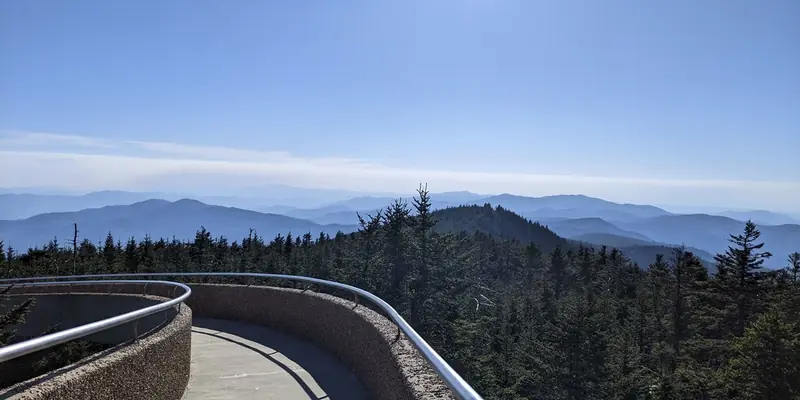
Beyond the famous overlooks is a landscape of changing forests, living history, and extraordinary small things. A better park visit begins with a little context.
You can drive through the Smokies, take the photograph, and leave with the impression that you have seen them.
You have certainly seen something beautiful. But the park gets much more interesting when you know why the forest changes as the road climbs, why an open valley contains churches and a mill, and why the most remarkable animal on a walk might fit comfortably in your hand.
Context changes the day. An overlook becomes more than a place to prove you were there. A historic building becomes evidence of a community. A patch of forest asks you to pay attention instead of asking how far it is to the next stop.
For a first visit, that is the approach we recommend: learn a little, choose an area, and leave time to notice what makes it distinct.
The quick answer: Great Smoky Mountains National Park has no entrance fee, but any vehicle parked longer than 15 minutes needs a parking tag ($5 a day). For a first visit, pick one area per day: Newfound Gap and Kuwohi for high mountain views, Cades Cove for history and wildlife (allow at least two to four hours), or Sugarlands Visitor Center for an easy start. Kuwohi Road closes in winter, typically December through March.
The park changes as you climb
Driving from the park's low valleys to its high peaks takes you through forest ecosystems comparable to a drive from Georgia to Maine, according to the National Park Service's Sugarlands itinerary. A streamside walk and a high mountain viewpoint can feel like different vacations, even inside the same park boundary.
Watch the landscape as you go: the trees, the sense of enclosure, the relationship between road and ridge. Resist treating every pullout as interchangeable. Stop where parking is permitted, look back the way you came, and give the view enough time to become a place rather than a backdrop.
The climb also changes the weather. Breakfast weather doesn't follow you up the mountain. Check the forecast for where you're going and bring layers.
The famous blue haze has a scientific story
The Cherokee called these mountains Shaconage, "the place of blue smoke." NASA explains the science: plants release volatile organic compounds, which react in the air to form tiny particles called aerosols. Those particles scatter blue-violet light, creating the bluish haze.
That is a lovely fact to carry to an overlook. The forest helps shape the way you see the mountains beyond it.
Not every hazy day is the famous natural effect, though. The park experiences some of the highest measured air pollution of any US national park, mostly from sources outside the Smokies, according to the NPS air quality profile. The landscape has an atmospheric story, and conservation includes what reaches it through the air.
The rocks tell a much older story
The park's geology spans more than a billion years of Earth history, according to the NPS geology overview. Its oldest sedimentary rocks formed 800 to 545 million years ago. Between about 310 and 245 million years ago, North America collided with Africa, pushing up the ancestors of these mountains. Erosion has been carving them down ever since.
Waterfalls are where that history becomes visible in motion. Most of the park's falls formed where streams hit ledges of hard metasandstone, which erodes more slowly than the slate around it. Instead of asking only how far the waterfall is from the parking area, ask why it's there. The answer gives you something worth noticing once you arrive.
Newfound Gap and Kuwohi answer different questions
If your priority is high mountain scenery, Newfound Gap and Kuwohi are the names you'll meet first. They belong in the same plan, but they are not the same stop.
Newfound Gap is the mountain pass on Newfound Gap Road, the main road across the park, on the Tennessee–North Carolina line. It's also where the Appalachian Trail crosses the only road it meets in the park.
Kuwohi is the highest point in the park and in Tennessee, at 6,643 feet. It sits at the end of its own road. The observation tower, built in 1959, is reached by a paved half-mile walk each way that the park describes as very steep, with benches to rest along the way. Kuwohi Road closes for winter, typically December through March; check the seasonal road schedule before you plan around it.
Older maps still say Clingmans Dome. In September 2024, the U.S. Board on Geographic Names approved restoring the Cherokee name Kuwohi, "mulberry place," at the request of the Eastern Band of Cherokee Indians, per the NPS announcement. Use Kuwohi. It's the mountain's name, and now its official one.
Our Kuwohi and Newfound Gap guide helps you plan the drive and match the walk to your group.
Cades Cove: read the valley as a former neighborhood
Cades Cove is an 11-mile, one-way loop road around a valley south of Townsend, and the park recommends allowing at least two to four hours, longer if you walk. The loop is open sunrise to sunset. It's closed to cars on Wednesdays, typically May through September, when it belongs to walkers and cyclists. Details are in the NPS Cades Cove guide.
You can treat it as a scenic drive. It gets considerably richer when you remember that people once organized ordinary lives across the landscape you're admiring. European settlers arrived between 1818 and 1821, and by 1830 the cove held 271 people. Cades Cove has the widest variety of historic buildings in the park: three churches, a working gristmill at Cable Mill, barns, and log houses.
Instead of photographing every structure and moving on, choose a few to understand. Pick up the self-guiding tour booklet at the start of the loop. Ask what each building was for, what work happened there, and what had to be done before anyone had the luxury of admiring the view.
Traffic is heavy in summer, fall, and on weekends year-round, so avoid a tight appointment right after. Our Cades Cove planning guide covers stops and timing. If Cades Cove is the main event of your trip, Townsend is the closest base; see where to stay in the Smoky Mountains.
The wildlife story is larger than bears
Bears understandably command attention. The park has the densest black bear population in the US, according to the NPS. They also tend to monopolize the conversation, as if the rest of the animal kingdom had arrived as supporting cast.
The Smokies are nicknamed the "Salamander Capital of the World." The park is home to 31 salamander species and 14 species of frogs and toads, according to the NPS amphibian guide. High elevations mimic northern climates, so species like the Carolina northern flying squirrel and Canada warbler live far south of their usual range, per the park's animal guide.
This is an invitation to change how you look. Pause long enough to hear birds. Watch without handling animals or turning the landscape over in pursuit of a sighting. A child noticing movement beside a trail may be having a more interesting encounter than the adults scanning for something large and photogenic.
The rules are firm. Stay at least 50 yards from bears and 25 yards from elk, which live on the North Carolina side of the park. Approaching, feeding, or disturbing wildlife is illegal, and violations can bring fines or arrest, per the NPS wildlife viewing guide. Bring binoculars or a longer lens instead.
A successful wildlife day doesn't require a particular animal to appear. That expectation puts pressure on the visitor and, too often, on the animal.
A short walk can be a complete experience
There is a persistent idea that a serious park visit needs a serious hike. It leaves out many people and pushes others onto the wrong trail.
Pick a walk for the group, not for the most enthusiastic person in the car. Look at elevation gain, footing, distance, and daylight. Our Smoky Mountain hiking guide walks through that choice.
For visitors with mobility needs, one fact matters most: the Sugarlands Valley Nature Trail, just south of Sugarlands Visitor Center, is the park's only ADA-accessible trail. The park also offers off-road wheelchairs for select trails (reservable May through October) and lends mobility devices at Sugarlands and Oconaluftee visitor centers. Details are on the NPS accessibility page.
You can also decide that a scenic drive, a visitor center, and one good stop are enough for the day. A worthwhile visit is measured by the experience you have, not by whether you return with muddy boots.
Know the practical rules before the scenic part
- Parking: There's no entrance fee, but any vehicle parked longer than 15 minutes needs a tag: $5 daily, $15 weekly, or $40 annual. A tag doesn't guarantee a spot. Buy and print it at home to skip the lines; see NPS parking tags.
- Pets: Pets are allowed in campgrounds, picnic areas, and along roads on a leash no longer than 6 feet. Only two trails allow them: the Gatlinburg Trail and the Oconaluftee River Trail. A dog-friendly cabin doesn't make a dog-friendly park day; see NPS pet rules.
- Navigation: The park warns that GPS can send drivers the wrong way on one-way roads or to dead ends. Pick up a free park road map or download the NPS app before you lose signal; see NPS directions.
- Closures: Check current conditions before you go. One example first-timers often miss: Laurel Falls Trail was closed for rehabilitation as of the park's August 2026 update.
Build a day with a subject
Here are three ways to organize a first park day. Each picks one area, so you spend the day looking instead of driving.
A landscape day: Start at Sugarlands Visitor Center, walk the Sugarlands Valley Nature Trail, then drive Newfound Gap Road to Newfound Gap and, from April through November, up to Kuwohi. If clouds sit on the peaks, turn around. The mountains will be there tomorrow.
A history day: Give it to Cades Cove. Pick up the tour booklet, choose three buildings to understand, and bring food and water. Leave the evening flexible.
A close-looking day: Choose a short walk and one subject: wildflowers, birds, salamanders, or the stone walls and homesites of an older human landscape. The objective is attention, not a long list of destinations.
We manage cabins at Douglas Lake, near Dollywood, on the Spur, and in Eagle Springs. Our Gatlinburg office is on Glades Road. Tell us what kind of day you want, and we'll tell you where to start it.
Questions about a first visit to the Smokies
Does Great Smoky Mountains National Park have an entrance fee?
No. The park charges no entrance fee, but any vehicle parked longer than 15 minutes needs a parking tag: $5 daily, $15 weekly, or $40 annual. A tag doesn't guarantee a parking spot.
Can you enjoy the Smokies without hiking?
Yes. Newfound Gap Road, Cades Cove Loop Road, visitor centers, and overlooks all work from the car. Check the walking at each stop: the Kuwohi tower, for example, is a steep half-mile walk from its parking area.
Is Kuwohi open in winter?
Kuwohi Road closes for winter, typically December through March. Under the 2026 schedule it was open April 1 through November 29. Newfound Gap Road stays open year-round, weather permitting.
Is Kuwohi wheelchair accessible?
No. The walk to the Kuwohi tower is paved but very steep. The Sugarlands Valley Nature Trail is the park's only ADA-accessible trail.
How long does Cades Cove take?
The park recommends at least two to four hours for the 11-mile loop, longer if you walk trails. The loop is open sunrise to sunset and closed to cars on Wednesdays, typically May through September.
Can I bring my dog to the park?
Only to campgrounds, picnic areas, roadsides, and two trails: the Gatlinburg Trail and the Oconaluftee River Trail. Dogs must be on a leash no longer than 6 feet.
How close can you get to bears in the Smokies?
No closer than 50 yards, or any distance that changes the bear's behavior. For elk, the minimum is 25 yards. Approaching or feeding wildlife is illegal.
Should you visit Cades Cove and Kuwohi on the same day?
For a first visit, give each its own day if you can. They're on different roads in different parts of the park, and combining them turns a day of looking into a day of watching the clock.
Explore SmartStay's things-to-do guides and our guide to the best time to visit the Smoky Mountains.
Sources
- NPS – Sugarlands itinerary
- NASA – The Place of Blue Smoke
- NPS – Park Air Profiles
- NPS – Geology
- NPS – Kuwohi Observation Tower
- NPS – Kuwohi name restored
- NPS – Seasonal Road Schedule
- NPS – Cades Cove
- NPS – Animals
- NPS – Amphibians
- NPS – Wildlife Viewing
- NPS – Accessibility
- NPS – Fees and Parking Tags
- NPS – Pets
- NPS – Directions
- NPS – Current Conditions